
At Speyer, Mathematics is much more than just finding an answer to a problem; instead, we see Mathematics as the way we reason about — and pose — problems.
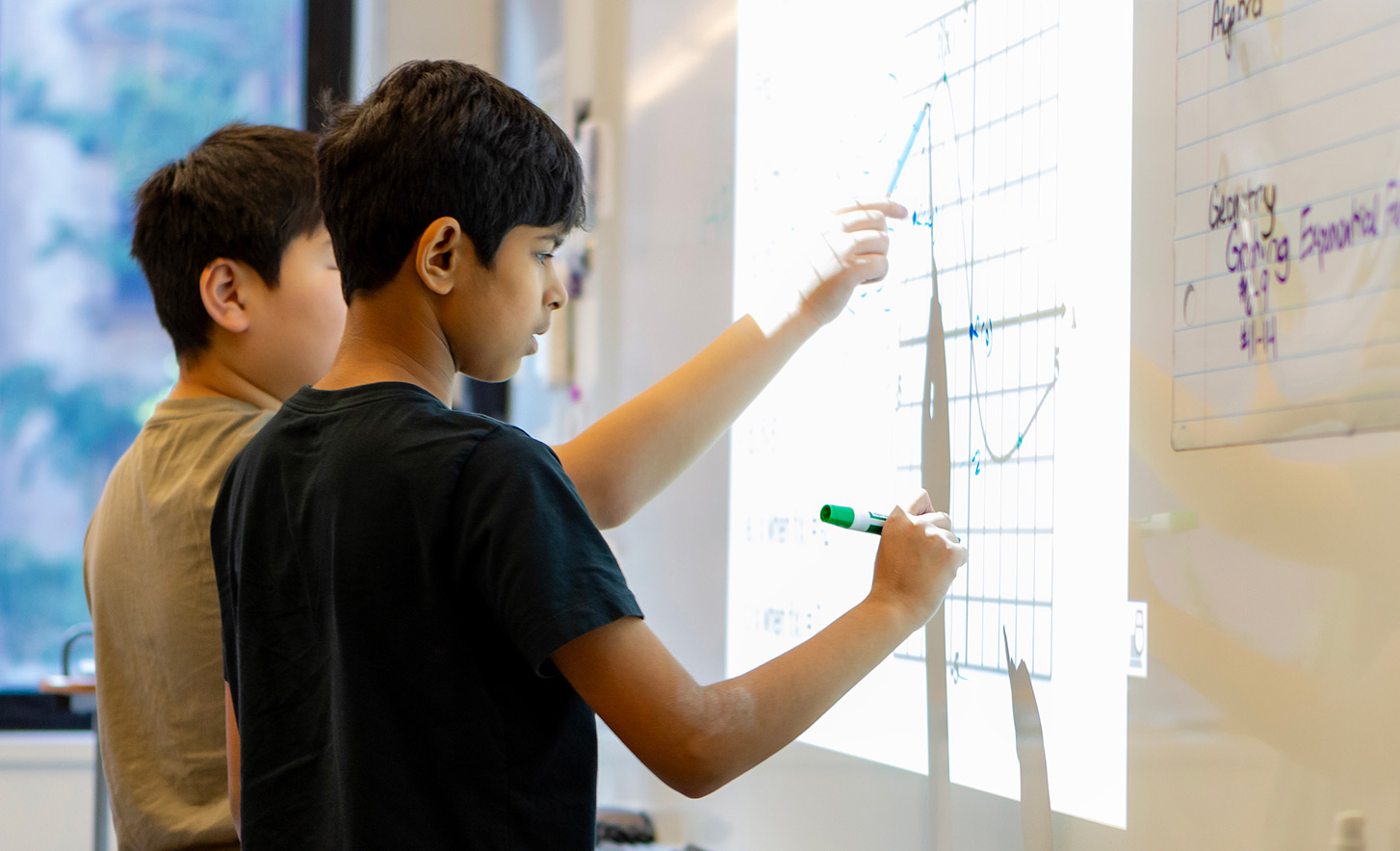
They also ask, among many other questions, whether they could have been more efficient in solving the problem and if their answer is the only possible one.
Speyer students develop fluency with numbers and variables and develop mastery of the traditional algorithms; however, we challenge them to see Mathematics as more than just memorizing procedures and performing calculations.
Through the development of explicit problem solving and metacognitive strategies, as well as through the way we invite and consider multiple potential solution methods and answers, we instill in our students a mathematician’s habits of mind: exploring, conjecturing, proving, estimating, checking, planning, abstracting, and generalizing.
We recognize that every student who arrives at Speyer is unique. Each student has a different history and relationship with Mathematics, coming to Speyer with differences in natural ability, prior knowledge, and the experiences and opportunities they’ve had related to Mathematics. To support our students, we form small groups for Mathematics instruction so that each student can receive increased teacher attention and feedback on their independent work; as students make progress and recognize their own progress, they grow in their self-confidence as capable and competent mathematicians.
As each student develops into a capable and competent mathematician, we also approach Mathematics as a social activity. Students regularly have the opportunity to complete work in groups, allowing students to learn from and build off of each other’s work. Every student is empowered to feel like they can provide meaningful contributions to group work; at the same time, students come to the realization that many problems require the collective expertise of a group whose individual members each bring their own unique strengths and perspectives.
Our goal is to ensure each student feels both supported and appropriately challenged, and we recognize that some students are ready to tackle more advanced Mathematics than their same-age peers. We place no ceilings on our students; we continuously monitor the growth of each student, and as students demonstrate mastery with the content being taught, our faculty members collaborate to create individualized and small group learning plans consisting of enrichment or increased acceleration. Our students are actively learning and being challenged every day, and there is always more to learn.
Though Mathematics is already worth studying, and is best studied, for its own sake as a distinct, pleasurable, and intellectually rich subject, Mathematics also has a practical use meriting its study and granting it a privileged place among other subjects — it provides a shared language and a toolkit practitioners of all fields can use to represent, to understand, and to better the world we live in. We aim to lay the foundation for our students to pursue an applied or pure mathematics career path should they choose, as well as those that may use math in their everyday lives.
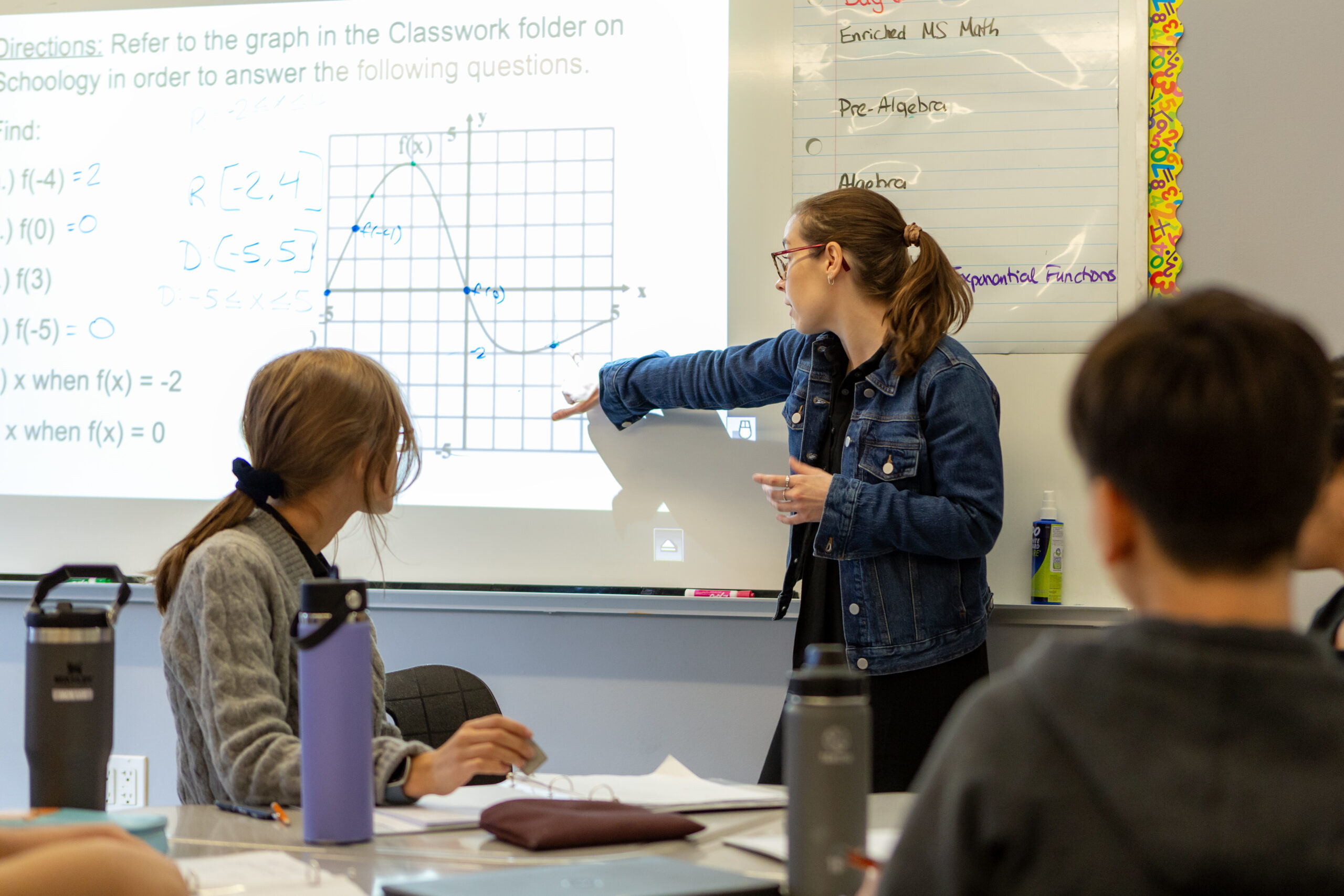
In the Lower School, Math periods are combined across both homeroom classes, which allows for five teachers (the four grade-level teachers and our Lower School Math Specialist) to lead small-group instruction allowing for greater differentiation.
The accelerated Math curriculum incorporates Singapore math along with other math curriculum but, overall, focuses on material designed by our own Math faculty to meet the needs of our gifted learners. Our students have math instruction five to seven times per six-day cycle.
As our students progress from grade to grade, our goal is to expose students to a variety of techniques to add versatility in their mathematical thinking opposed to applying algorithms. This enables students to focus on conceptual understanding beyond basic computation. In addition to strengthening students’ facility in making calculations, we emphasize decoding and solving complex word problems. Students develop the essential skill of reading a problem and determining what calculations are required to determine a solution.
Problem solving and perseverance are two constant themes in our Lower School Mathematics instruction. There is an internal joy that can be found by solving a difficult puzzle or exploring a situation. The ability to persevere with a task that at first seems unattainable is one of the many ways we try to challenge our students.
In addition to their day-to-day math instruction, students are offered the opportunity to participate in a variety of math competitions and events throughout the school year, including the Noetic Math and Continental Math League competitions and the Mathematical Olympiads for Elementary and Middle Schools. Lower School students also compete in the Girls’ Adventures in Math, a contest originated in 2016 by Speyer in cooperation with Math-M-Addicts. All students have the opportunity to enroll in various afterschool offerings such as Mathletes and Girls’ Mathletes, as well as other math-focused options.
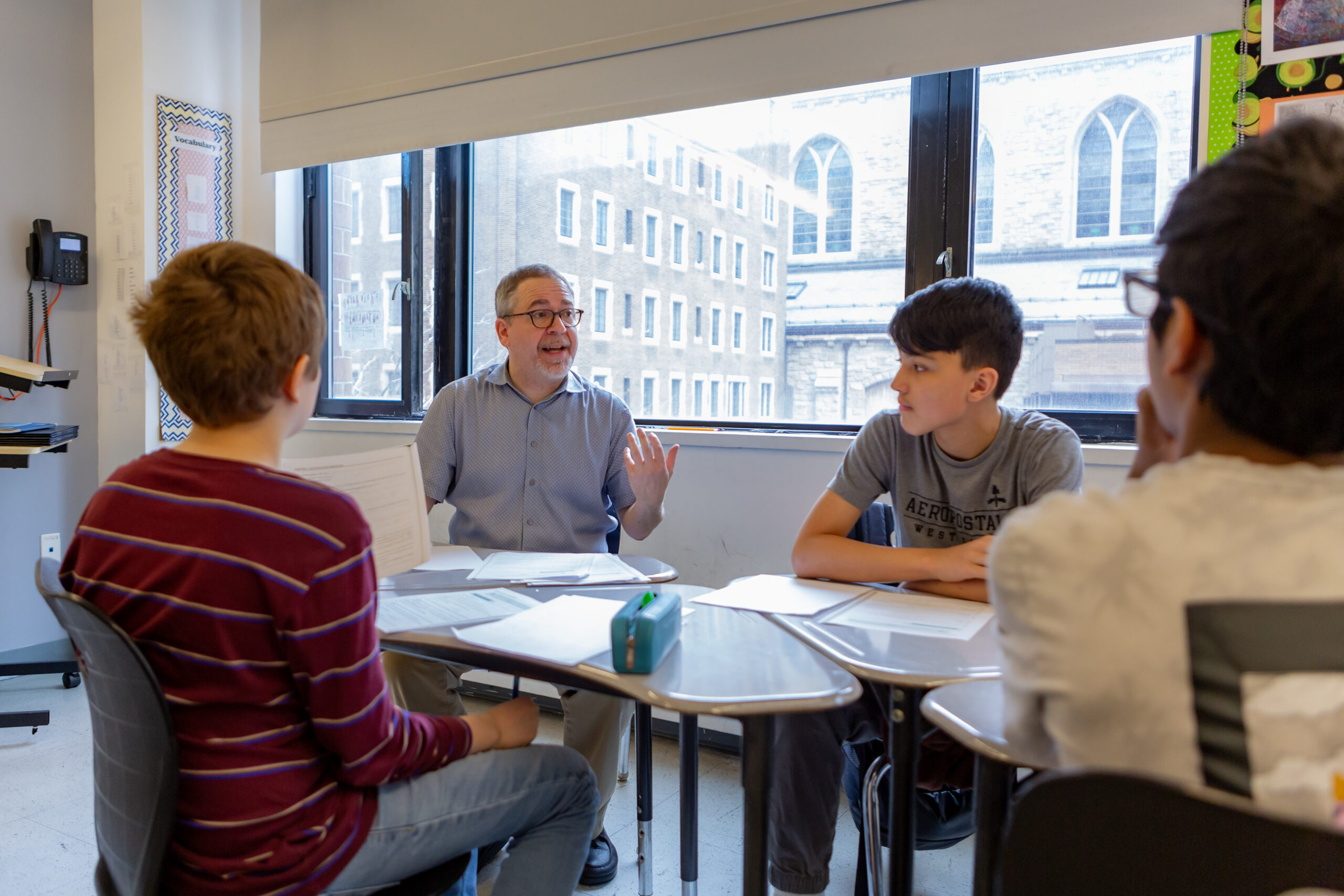
All Speyer graduates receive at least one full year of high school or higher level instruction. Fifth and Sixth Grade courses condense what would normally be considered Middle School mathematics into a two-year sequence. Our Seventh and Eighth Grade mathematics courses are distinct from most Middle School curricula in their emphasis on topics such as mathematical proof, number theory, and combinatorics. Exceptionally accelerated students have the opportunity to study College Algebra, Precalculus, Calculus, and other college-level material.
Speyer’s Middle School Math Program operates with the guidance of four basic principles: acceleration, customization, depth of knowledge, and math for pleasure.
All Math curricula in Speyer’s middle school are accelerated by at least one year with respect to a student’s nominal grade level.
While all Speyer students take accelerated math, they also display a rich variety of personal interests and academic profiles. Our mission in math is to enable each student to proceed at the pace that is natural for them. We therefore offer four different math courses to each of Speyer’s Middle School grades. Many of our fifth and sixth graders take Pre-Algebra courses, while others in those grades are ready for high school-level math. Our seventh and eighth graders tend to follow high school curricula (Algebra 1, Algebra 2, Geometry, Trigonometry), but for students who are ready, exceptionally advanced classes like Precalculus or Calculus are also available.
Perhaps the most exciting part of studying math is this critical distinction: even for a young student, math enables us to learn not only that something is true, but also why it has to be true. Speyer students are hungry for deep and structured knowledge. Accordingly, our math courses emphasize rigorous exploration, technical proficiency, and proof. Whether they are composing an intricate animated presentation, deriving an equation from simpler principles, etc. Speyer students strive to solve problems for themselves, and aim to demonstrate the validity of their solutions.
There are many reasons to study math, but none is more compelling than sheer intellectual delight. We want Speyer students to learn not just that math is useful, but that it is beautiful, exciting, and endlessly surprising!
Speyer also offers two Afterschool Math Teams: a Junior Varsity team for students in Fifth and Sixth Grades and a Varsity team for students in Seventh and Eighth Grade (students in other grades may be invited to participate with the Varsity team on a case-by-case basis). Members of our Middle School Math teams represent Speyer in several prestigious competitions, including AMC 8 and AMC 10, MATHCOUNTS Manhattan and New York State MATHCOUNTS Competition, Math Olympiads for Elementary and Middle Schools, and New York Math League. Speyer students also compete in the Girls’ Adventures in Math, a contest originated in 2016 by Speyer in cooperation with Math-M-Addicts.
Examples of our Lower School math curriculum and the skills and concepts explored by grade level is below. Please note that these lists are not the full scope of the math curriculum for each grade — they are highlights of the minimum level of mastery for each skill. If a student demonstrates mastery of ability beyond these concepts, our faculty works to ensure their learning potential is supported.
Fifth Grade courses in Accelerated Middle School Mathematics and Enriched Middle School Mathematics synthesize and generalize the material learned in the Lower School and incorporate both informal and formal early algebraic thinking and reasoning. For students already demonstrating mastery in our accelerated curriculum, Speyer occasionally offers Fifth Grade Pre-Algebra and Problem Solving courses that serve the needs of profoundly math-gifted students who show a personal drive to study Mathematics at an exceptional pace.
All Sixth Grade courses serve as courses in Pre-Algebra. Sixth grade students take either Accelerated Pre-Algebra or Enriched Pre-Algebra, and students particularly gifted in Mathematics have the opportunity to study much, or even all, of a high school Algebra 1 course.
In Seventh Grade, a Speyer student gains a more formal understanding of Algebra and different function families by following one of three curricula: Introduction to Algebra; Algebra 1; or Algebra 1 and 2.
In Eighth Grade, a Speyer student develops their visualization skills and spatial thinking through a course in either Bridge to Geometry, Euclidean Geometry, or Euclidean Geometry and Trigonometry. Speyer also offers Eighth Grade Precalculus and Calculus courses that for those students who are profoundly gifted in math show a personal drive to study Mathematics at an exceptional pace.